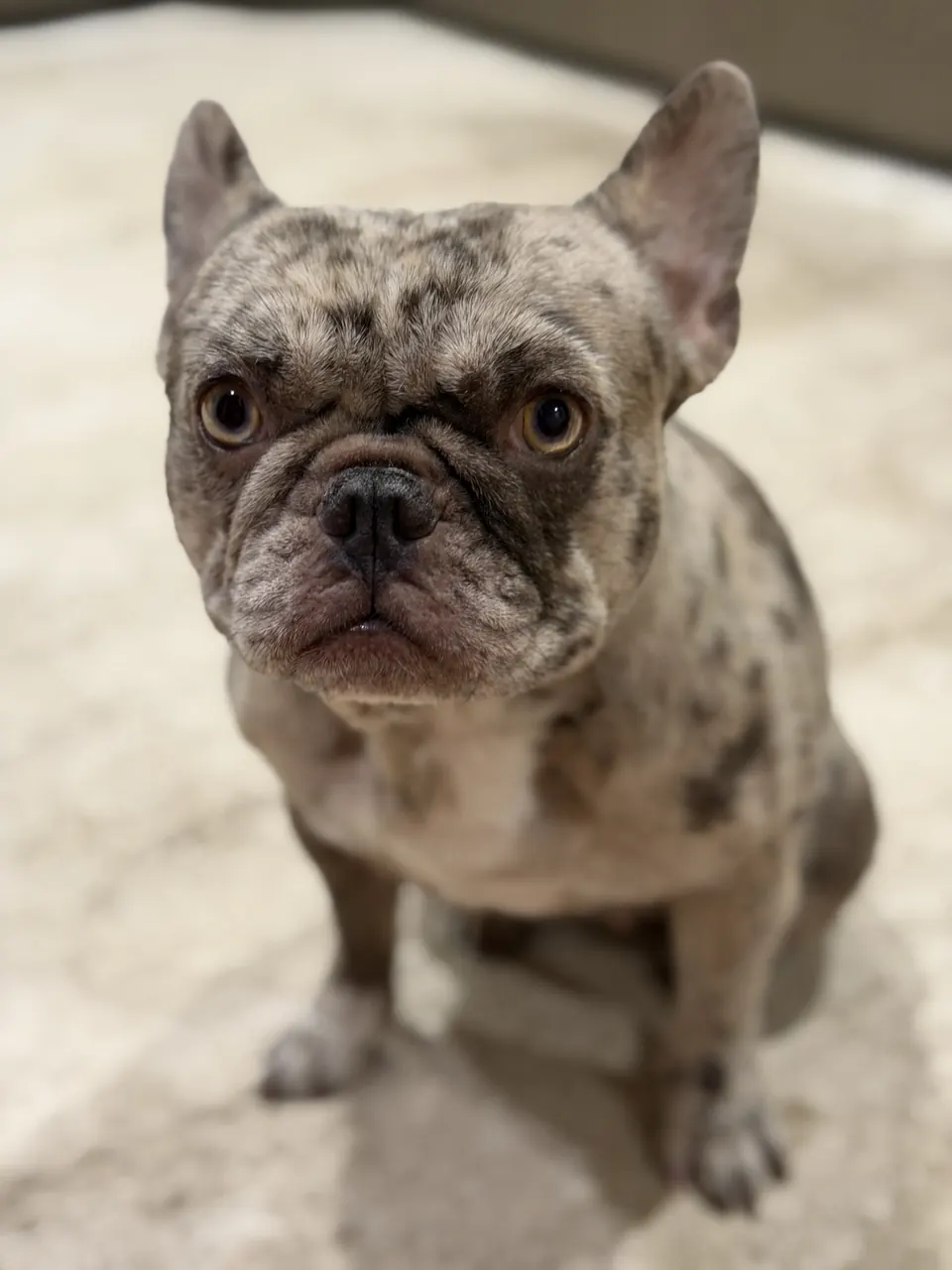
 Maggie the Merle
Merle French Bulldogs: the health facts, plainly
Not veterinary advice. This is general information gathered from veterinary schools and published research. It isn't a diagnosis or a treatment plan. Talk to your veterinarian about your own dog, and if your Frenchie is struggling to breathe, collapses, or overheats, go to an emergency vet now. Full disclaimer.
Why we wrote this
Maggie is a merle, and we love her. We also think owners deserve the actual facts, without marketing claims like "rare" or "premium" and without scare stories. Everything below comes from a veterinary genetics lab, the AKC, a peer-reviewed review, a veterinary manual and the breed clubs, all linked at the bottom.
Our position: this page is about caring for a merle you already have. We don't promote merle breeding or sales, and we don't link to breeders.
The genetics in two minutes
- Merle comes from a SINE insertion in the PMEL (SILV) gene. It dilutes dark (eumelanin) pigment in patches. (UC Davis VGL; AKC)
- It's incompletely dominant: one copy (single merle) produces the pattern. (UC Davis VGL)
- The insertion varies in length, which is why some dogs show almost no pattern ("cryptic" merle) while others are heavily diluted. A DNA test is the reliable way to know. (UC Davis VGL; AKC)
- Two merle parents produce, on average, about 25% double-merle puppies. (AKC)
Single merle vs double merle
| Single merle (one copy) | Double merle (two copies) | |
|---|---|---|
| Hearing | Slightly higher deafness risk; the chance of deafness in both ears is still under 1% (AKC) | Much higher risk of deafness (AKC; UC Davis VGL) |
| Eyes | Blue or partly blue eyes are common with merle; a range of eye defects is possible (UC Davis VGL) | Often small eyes (microphthalmia) and abnormal pupils (AKC) |
| Other | — | May have skeletal, heart and reproductive abnormalities (UC Davis VGL) |
What the breed clubs say
The French Bull Dog Club of America's breed standard and the AKC standard list merle as a disqualifying color. The UK Kennel Club does not register merle French Bulldogs. A merle Frenchie can still be a much-loved pet. It just can't be shown under those standards.
Checks to ask your vet about
- Hearing: a BAER test is objective. The MSD Veterinary Manual notes that behavioral tests can miss deafness in one ear or partial hearing loss.
- Eyes: a thorough eye exam. French Bulldogs also have breed-related eye conditions (see the ECVO breed sheet).
- Breathing: like every Frenchie, have your vet assess airway function. The Cambridge BOAS group uses a functional grading scheme.
- Genetics: a merle DNA test tells you how many merle copies your dog carries.
FAQ
What causes the merle coat pattern?
An insertion (called a SINE) in the PMEL gene, also known as SILV. It's incompletely dominant, so one copy is enough to produce the pattern. Source: UC Davis Veterinary Genetics Laboratory.
Are merle French Bulldogs deaf?
Most single merles aren't. The AKC notes that one merle copy slightly raises deafness risk, but the chance of a single merle being deaf in both ears is still under 1%. Double merles (two copies) are at much higher risk. An objective BAER hearing test from a vet is more reliable than watching how your dog reacts to sound.
What is a double merle?
A dog with two copies of the merle variant, usually from breeding two merles together. Double merles may have hearing, eye, skeletal and other defects, which is why breeding merle to merle is discouraged. On average, about a quarter of puppies from a merle-to-merle litter are expected to be double merle.
Is merle an accepted French Bulldog color?
No. Merle is a disqualifying color in the French Bull Dog Club of America and AKC breed standards, and the UK Kennel Club doesn't register merle French Bulldogs.
What checks should a merle Frenchie get?
Ask your vet about a hearing (BAER) test and an eye exam, along with the usual Frenchie checks for breathing, spine and skin. A DNA test (for example from UC Davis VGL) can confirm how many merle copies a dog carries.
Sources
- UC Davis Veterinary Genetics Laboratory: Merle
- American Kennel Club: Merle in dogs (C. Coile, PhD)
- Being Merle: the molecular genetic background of the canine merle mutation (review, PMC)
- MSD Veterinary Manual: deafness in animals
- ECVO manual: French Bulldog
- French Bull Dog Club of America: breed standard
- French Bull Dog Club of America: interpretation of the standard on color
- AKC official French Bulldog standard (PDF)
- Royal Kennel Club: French Bulldog
- University of Cambridge BOAS research group