 Maggie the Merle
What size crate for a French Bulldog?
Heads up: we earn a commission if you buy through links on this page, at no extra cost to you. That never changes what we recommend or the order we list things in. How we make money.
Quick crate-size helper
Enter your dog's measurements. The helper adds the AKC's 3–4 inch margin.
How to measure
- Length: with your dog standing, measure from the tip of the nose to the tip of the tail.
- Height: from the top of the head to the floor (AKC). Measuring to the tips of those bat ears instead gives a little extra headroom, so your dog can stand without ducking (Cornell).
- Add 3–4 inches to each number. That's the minimum interior length and height to look for (AKC).
- Check the product's interior dimensions. Crates are sold by a nominal size (often the outside length), and the inside can be smaller.
Too small and your dog can't stand, turn or stretch out. Too big and, during house training, a puppy may use one end as a bed and the other as a toilet (Cornell, AKC). That's what dividers are for.
Which type of crate?
| Type | Pros | Cons | Shop |
|---|---|---|---|
| Wire | Folds flat; good airflow and visibility; often includes a divider (Cornell) | Not pretty; some dogs like a cover for a den feel (leave sides open for air) | Chewy · Amazon |
| Plastic | Easy to clean; many double as travel carriers (AKC) | Bulkier to store; check ventilation for a heat-sensitive dog | Chewy · Amazon |
| Fabric / soft | Light and foldable; good for travel or short use (Cornell) | Not durable; puppies and chewers may destroy them | Chewy |
| Furniture-style | Blends in as an end table (AKC) | Pricier, heavier, harder to clean | Amazon |
Frenchie extras: put the crate somewhere cool, out of direct sun and away from heaters, and make sure covers never block airflow. Flat-faced dogs handle heat poorly (see our heat guide).
Bed sizing
- In the crate: match the crate's interior floor dimensions so the bed lies flat without bunching.
- Outside the crate: measure your dog lying down the way they usually sleep, from nose (or front legs) to rump, then add 9–12 inches. That's the rule bed maker Snoozer publishes, along with "when in doubt, size up." Compare against the bed's interior dimensions; round beds are listed by diameter.
- Shape: a raised edge (bolster) gives a flat-faced dog somewhere to rest the chin. More on beds in our home & sleep guide.
Browse crate mats Browse bolster beds
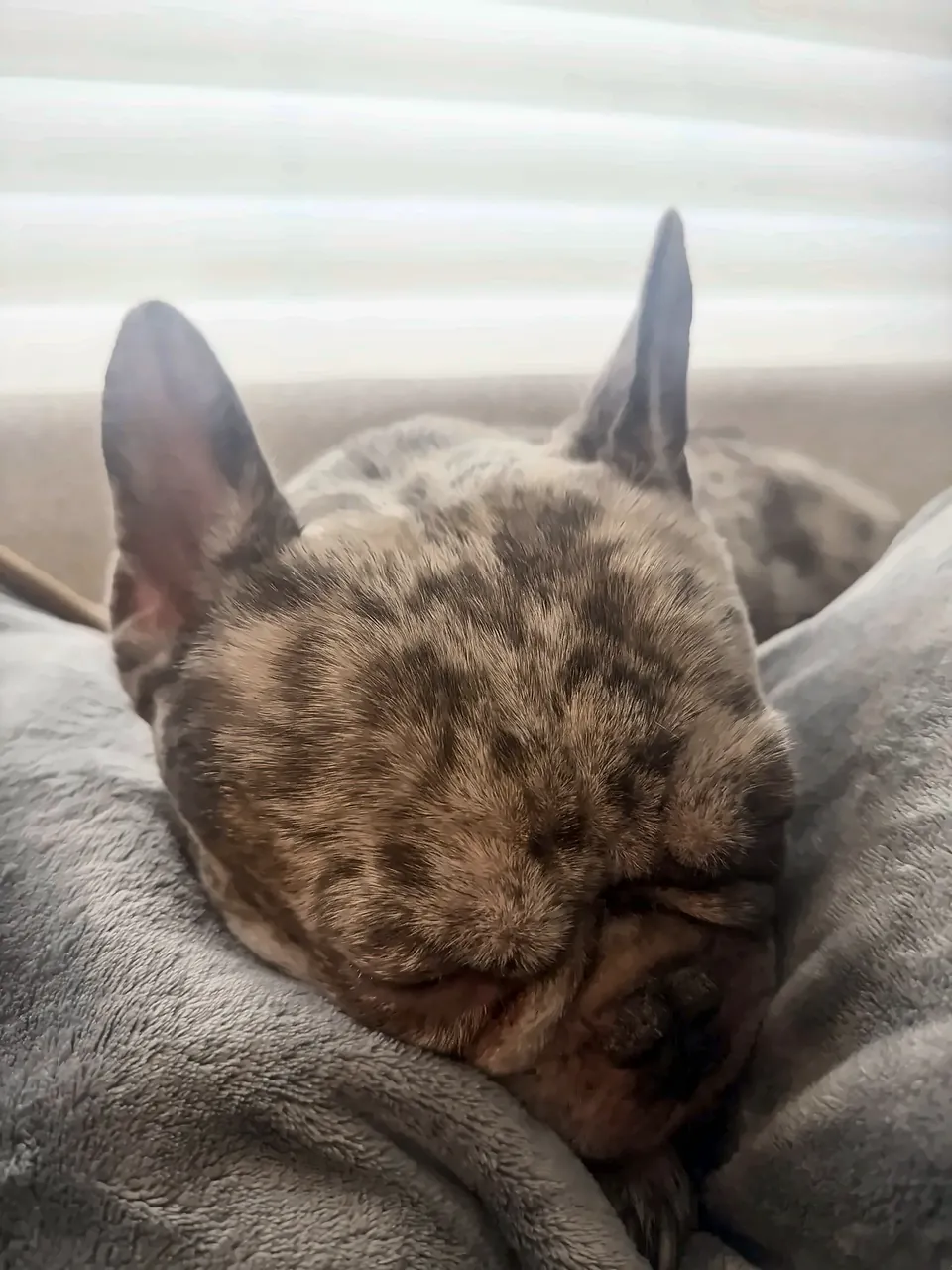
Where Maggie actually sleeps
Measure all you want: Maggie's favorite spot is our extra-large bean bag, and her second favorite is wedged between the couch cushions. If your Frenchie is a sprawler too, it's one more reason to size beds up rather than down.
FAQ
What size crate does a French Bulldog need?
Measure your own dog instead of going by breed. The AKC method: with your dog standing, measure nose tip to tail tip (length) and top of head to floor (height), then add 3 to 4 inches to each. Choose a crate whose interior is at least that big. Your dog should be able to stand without ducking, turn around and lie down comfortably.
Should I buy a puppy crate or an adult-size crate?
Both the AKC and Cornell suggest buying a crate that fits your dog as an adult and using a divider panel while your puppy is small, so you don't have to buy multiple crates. A divider keeps the space small enough during house training.
Wire or plastic crate for a Frenchie?
Wire crates fold for storage, often come with dividers and let air flow through, which matters for a heat-sensitive breed. Plastic crates are easy to clean and many double as travel carriers. Fabric crates are lightweight but, Cornell notes, puppies and chewers may destroy them.
What size bed fits in the crate?
Use the crate's interior floor dimensions, not the outside. For a bed outside the crate, one bed maker (Snoozer) suggests measuring your dog lying down as they normally do and adding 9 to 12 inches, and going up a size when in doubt.
How long can a Frenchie stay in a crate?
There's no single number. Cornell says a dog should never be left crated for an extended period without the chance to relieve themselves, play and exercise, and that dogs who bark, pace, pant, drool or soil the crate when confined shouldn't be forced to stay. Keep the crate in a cool spot out of direct sun.